

Note: As an Amazon Associate, I earn from qualifying purchases.
For most of my life, getting dressed isn’t something that occupied too much of my mental energy. Sure, there were a few mornings that I hated everything I put on, but I didn’t have to worry if I’d be able to tie my shoes or fit a shirtsleeve over my prosthetic.
Over the past few months, I’ve recycled or donated a large portion of my wardrobe that no longer fits my needs and have slowly been rebuilding with pieces that are more functional and still make me feel put together and professional. If you are on a similar journey, here are a few tips to guide you while building an accessible wardrobe.
Choose Clothing that Eliminates Frustration
You know your tolerance for frustration better than anyone else, but getting dressed is one of the first things you’ll do and will help set the tone for the rest of the day. Since my accident was fairly recent, most tasks involve some element of frustration, so I decided not to start my day struggling with the button fly on my former favorite pair of jeans, and save that mental energy for tasks I encounter later in the day.
Style is extremely personal and maybe you’re willing to endure a little more frustration to keep wearing a favorite outfit. There are easier alternatives, however, so play around with more accessible items and see what makes sense for you. I swapped all of my jeans for pull-on pants, for example. (You can find one of my favorites here.)
Look for Loose Sleeves and Pant Legs
Loose sleeves are especially important for upper extremity amputees, especially if the amputation was recent or you wear (or plan to wear) a prosthetic. For the first few months, I had a lot of limb pain and swelling, so it was helpful not to have to worry about tight sleeves adding extra pressure or not fitting. Now the size of my limb is pretty stable, but I use a myoelectric prosthetic which has a significantly bigger circumference than a normal arm.
As for pant legs, fitted pants like leggings or skinny jeans are simply harder to get on and off with one hand. It’s possible, but it may not be a battle you want to fight multiple times per day. Luckily, straight-leg jeans are trendy right now anyway.
Opt for Slip-On Shoes Over Lace-Up

Maybe someone has perfected tying shoes with one hand, but I have yet to figure it out, so instead, I wear slip-ons. Amazon sells elastic shoelaces that you can use to convert your favorite boots and sneakers into slip-ons. I also like these sneakers from Tao for a more casual office environment. Ankle boots with a short zipper are a great dressier alternative.
Use Available Tools
After my amputation, I struggled to find and use single-handed tools to make my life easier. First, it’s hard to know what will actually be helpful and worth spending money on, and secondly, I didn’t want to feel like I had to rely on a bunch of extra tools just to function. The most helpful items I’ve found for getting dressed, however, are a button hook with zipper pull and a shoehorn.
Limit Complicated Fasteners
I mentioned earlier switching from jeans to pull-on pants, but pants aren’t the only article of clothing that can make your life more difficult. I generally try to avoid clothing with a lot of buttons. (Though you can get around this by leaving all but the top few buttons fastened and pulling the shirt or dress on over your head.) I also don’t like zippers that are off to the side or on the back and wraparound dresses or dresses with bows. As for undergarments, I look for bras and bralettes that are pull-over rather than fastened with a clasp.
Lay Out Your Outfit the Night Before
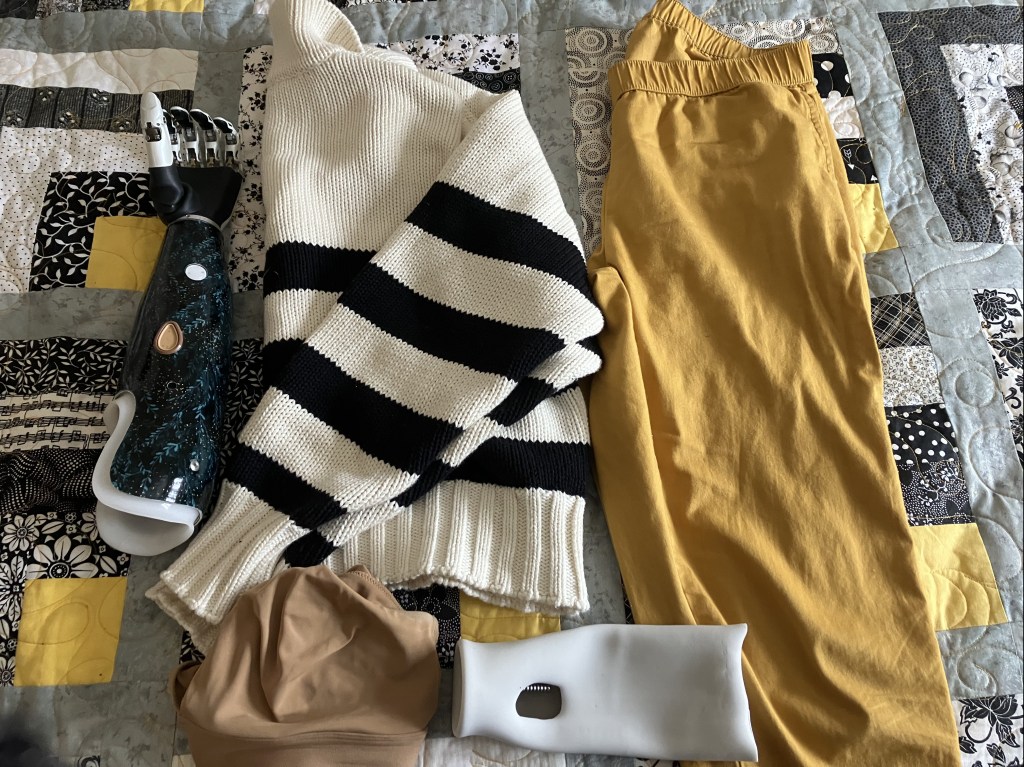
Since my amputation, getting ready for the day takes a little longer than before, and I’ve had a hard time adjusting my schedule to provide the additional 7-ish minutes I need in the morning. One way I get around this is by laying out my outfit the night before. That way I know I have a comfortable, easy, and appropriate outfit ready to go first thing in the morning.
Bonus: Purchase Compression Sleeves
For the first 6-ish months after my amputation, I had to wear tubular elastic bandage around my arm for compression and healing, but I hated the way it looked. The doctor and prosthetist didn’t think I would be able to find compression sleeves that were the right size for my arm since I’m fairly small and have a long residual limb. I eventually found these sleeves available on Amazon that are more comfortable and also look more polished than the elastic bandage. I use them on days I don’t feel like wearing my prosthetic, and they come in a variety of sizes and colors.
 Page Writing Pages LLC
Leave a comment